Exodus 8:6—9:7
Ministries > Thru the Bible with Dr. J. Vernon McGee
https://www.oneplace.com/ministries/thru-the-bible-with-j-vernon-mcgee/
Facebook Twitter Instagram YouTubeWarning: Along this stop on the Bible Bus, we will encounter dead cattle, flies, lice, and a whole lot of frogs. Are you in? Each of these nasty plagues can teach us something significant about the ancient gods of Egypt and, in turn, about the idols we harbor in our own hearts today.
References
Steve Schwetz: Egypt is overrun by plagues, yet instead of yielding, Pharaoh keeps hardening his heart against God. And as the pressure builds, he begins to bargain. Welcome to Thru the Bible. I'm your host, Steve Schwetz, on this five-year journey through God's Word. And our teacher, of course, is Dr. J. Vernon McGee, and he walks us through two of Pharaoh's proposals and draws a striking parallel to the kinds of compromises Christians can be tempted to make as well. But before we turn to our study, let's listen to something that Dr. McGee shared years ago about letter writing.
Dr. J. Vernon McGee: I have been absolutely startled and amazed that this past summer we asked questions in conferences. In fact, the directors would ask questions of the people that attended. How many of you listen to the Thru the Bible Radio? And we had it anywhere from 60% to 90%. And in an audience of a thousand people, the question then was asked, how many of you have ever written? Less than 100 people had written. And yet sometimes 900, 800 people were there and listened to the program. Now we feel like we're doing a pretty bad job not to encourage you to write to the program that you listen to. If you are getting a blessing here, and we always feel like people ought to support the place where they're getting the blessing. Our policy has been not to spend a great deal of time begging, but just to let you know what our policy is. We stay on a station as long as it supports itself, or almost supports itself. Then, if it doesn't, we give a little warning that we're going to have to go off the station unless we get the support. Then, if the support does not come in, and oftentimes it does, we go off the station if necessary and move to another one. So that has been our policy down through the years.
Steve Schwetz: You know, we love hearing from you and it makes a big difference for your local radio station too, if that's how you listen. So if you'd like to send us a letter or support the travels of the Bible Bus in your area and around the world, then get in touch with us today. Call 1-800-65-BIBLE or drop us a note in our app or send it to [email protected]. And you can always find us online too, ttb.org, or write to us in the US at Box 7100, Pasadena, California, 91109. In Canada, Box 25325, London, Ontario, N6C 6B1. And when you're in touch, be sure to tell us how or on what station you hear Thru the Bible. Let's pray for one another as we prepare to spend time in God's Word. Heavenly Father, thank You for Your Word that's applicable to each of us. Protect us from the deadly sin of compromise as we seek to be more like Jesus each day. It's in His name we pray. Amen. Open now to Exodus 8 as we go through the Bible with Dr. J. Vernon McGee.
Dr. J. Vernon McGee: Now today friends, as we return back to the eighth chapter of Exodus, we're seeing the judgment of the plagues upon the land of Egypt. These are directed actually at the gods of Egypt because Egypt was a land of idolatry, worshipping about 3,000 different gods and goddesses. The first we saw, the Nile was turned to blood. And then the second one, and actually, I'd like to call it a third one, although it's not customarily done so, of the frogs. Because the first one really was the rod of Aaron that became actually a crocodile. You see the land of Egypt was the place of zoolatry. They worshipped all kinds of animals and this one of the frogs is an example of it. And we saw that last time. I'd like to add a little bit more to it. The frogs actually were represented, of course, by Heka, as we mentioned last time. And Heka was a frog-headed goddess. But also there was Hapi, the bestower of nourishment. And they always depicted him, that is the Egyptians, as holding a frog out of his mouth that flowed with a stream of nourishment. And this, I think, shows the close relationship between the god of the Nile and Heka, the frog goddess, who was one of the oldest mother goddesses. She was the goddess of fertility and rebirth and the patroness of midwives. One Egyptian picture shows this frog-headed goddess reciting spells to affect the resurrection of Osiris, and a carving shows Heka kneeling before the queen and superintending at the birth of Hatshepsut. Now the frogs were very common in the land of Egypt. And so we find here this plague leveled against them. Now they were sacred, you didn't kill them. But when you get up of a morning, as we said before, and as it says here, they were in the bed and they were in every room in the home. They were in the kitchen, in the kneading troughs, in ovens. And I tell you, when they're sacred and you can't kill them, you've really got a problem with frogs. And we suggested last time that probably God was smiling. But now we come to the most amazing thing of all. Now this is a great miracle, but notice what happened as we read on, verse six. And Aaron stretched out his hand over the waters of Egypt, and the frogs came up and covered the land of Egypt. Now listen to this, and the magicians did so with their enchantments and brought up frogs upon the land of Egypt. Now the magicians could duplicate this. This is an amazing thing, by the way, and reveals the power of Satan, and this is satanic power. Verse eight, then Pharaoh called for Moses and Aaron and said, entreat the Lord that He may take away the frogs from me and from my people, and I'll let the people go that they may do sacrifice unto the Lord. And Moses said unto Pharaoh, glory over me, when shall I entreat for thee and for thy servants and for thy people to destroy the frogs from thee and thy houses, that they may remain in the river only? And he said tomorrow. And he said, be it according to thy word, that thou mayest know that there is none like unto the Lord our God. And the frogs shall depart from thee and from thy houses, from thy servants and from thy people. They shall remain in the river only. Now Moses and Aaron went out from Pharaoh, and Moses cried unto the Lord because of the frogs which He had brought against Pharaoh. And the Lord did according to the word of Moses, and the frogs died out of the houses, out of the villages, and out of the fields. And they gathered them together upon heaps, and the land stank. And when Pharaoh saw that there was respite, he hardened his heart and hearkened not unto them as the Lord had said. Now we get here a more comprehensive picture of the hardening. It says here Pharaoh hardened his own heart. You see all God did was just bring out what was already in a hard heart and that was to demonstrate that it was a hard heart. Now he did not repent even after this. And of course, the very fact his own magicians could duplicate it. Now verse 16. And the Lord said unto Moses, say unto Aaron, stretch out thy rod and smite the dust of the land that it may become lice throughout all the land of Egypt. And they did so, for Aaron stretched out his hand with his rod and smote the dust of the earth and it became lice in man and in beast. All the dust of the land became lice throughout all the land of Egypt. Now note this, and this is interesting. And the magicians did so with their enchantments to bring forth lice, but they could not. So there were lice upon man and upon beast. Then the magicians said unto Pharaoh, this is the finger of God. And Pharaoh's heart was hardened and he hearkened not unto them as the Lord had said. Now up to this point, the magicians were able to duplicate every miracle, but they're not able to duplicate this. Well, how had they done the others? Well, I must confess I don't know, but it raises the question: were they fakes? Were they really magicians in our understanding of it? Was it a trick that they were performing? Well, at least at this juncture, they acknowledge the finger of God and as it were God is gradually convincing them. But notice this plague of lice again. The plague of lice was that which actually had to do with the earth god, Geb or Gib. The judgment, of course, brought loathing upon Geb, the earth god. And he's closely related to the earth in all of its states. Geb was the one who made his report to Osiris on the state of the harvest, and from him came an emanation of holy oil in which the backbone was immersed in the work of making a mummy. So you see that this thing entered into the very life of these Egyptians. Actually, this word lice though, could mean gnats or mosquitoes. Gesenius made that alteration, by the way. And the root meaning means to cover or to nip or to pinch. And the very interesting thing is nipping or pinching or covering. I don't think that a mosquito could fulfill all that or actually a gnat, but certainly lice would. Here is a statement made by a leading zoologist. He says the mites form an enormous order whose function in life is a large extent to play the scavenger. Well, now you can well understand with all those frogs around and the record here says that the land was smelling bad, and these gnats could eventually get rid of them. They could become a blessing as well as a curse also. Now we have this word though, that was given by Mr. Bednell, and he tells about his experience in the land of Egypt. And I think this is quite interesting in connection with the lice. He says, I noticed that the sand appeared to be in motion. Closer inspection revealed that the surface of the ground was a moving mass of minute ticks, thousands of which were crawling up my legs. I beat a hasty retreat, pondering the words of the scripture: the dust of the land became lice throughout all the land of Egypt. The miracle now is one that could not be duplicated. God's beginning to level it against the very life in the land of Egypt. Now let's move on here in verse 20. And the Lord said unto Moses, rise up early in the morning and stand before Pharaoh, lo he cometh forth to the water, and say unto him, thus saith the Lord, let my people go that they may serve me. Else if thou wilt not let my people go, behold I'll send swarms of flies upon thee and upon thy servants, upon thy people, into thy houses. And the houses of the Egyptians shall be full of swarms of flies and also the ground whereon they are. And I will sever in that day the land of Goshen in which my people dwell, that no swarms of flies shall be there, to the end thou mayest know that I'm the Lord in the midst of the earth. And I will put a division between my people and thy people, tomorrow shall this sign be. You see up to this sign, this plague, why it had been on the land of Goshen where the children of Israel were. And a great many people were probably telling Pharaoh, well, after all they're suffering as well as our people. It's obvious that this is not from God but has a natural explanation or maybe one of our gods happens to be doing this. Well, now in this plague God makes a distinction. From here on, none of the plagues will touch the land of Goshen where the children of Israel are, and the judgment will be upon the land of Egypt. Now this is the judgment of the flies. That of the lice was against the earth god. But now the flies are actually here, they're beetles or scarabs as they are known in Egypt. Many of them gold that they found in the tombs in Egypt. They are sacred to Ra, the sun god, Ra Amon, and also to Khepri. These are the gods now that are being reached through this, and that which to the Egyptian was sacred, a place of worship, and now he's touching the main god and goddess of the land of Egypt, Ra Amon. And it causes Pharaoh at this time to want to reach some sort of a compromise with Moses. And notice now the proposal that Pharaoh did. I'm reading verse 24 now of the eighth of Exodus. And the Lord did so, and there came a grievous swarm of flies into the house of Pharaoh and into his servant's houses and into all the land of Egypt. The land was corrupted by reason of the swarm of flies. Actually that scarab spoke of eternal life. You find them in the tombs today. They were sacred as I say. Well, imagine this most sacred thing becoming a curse to the people and certainly a plague on all the land. So Pharaoh wants to work out a compromise, and you have two of them here. You'll find out later he'll make two more compromises, four compromises in all. And here is the first one now, verse 25. And Pharaoh called for Moses and for Aaron and said, go ye, sacrifice to your God in the land. You remember now Moses and Aaron had said, we want to go three days' journey in the wilderness and sacrifice. But now Pharaoh said, all right, sacrifice, but do so in the land. Now notice this, and Moses said, it's not meet so to do, for we shall sacrifice the abomination of the Egyptians to the Lord our God. Lo, shall we sacrifice the abomination of the Egyptians before their eyes and will they not stone us? We will go three days' journey into the wilderness and sacrifice to the Lord our God as He shall command us. Now this compromise, the first one of Pharaoh, is the same kind of a compromise that is given to Christians today, and it's always satanic. And this first compromise is just simply this. It says be a Christian, and we think that's very nice for you to be a Christian, but don't be a narrow Christian. Be broad-minded. Fact of the matter is what they really mean is don't change your life. And friends, if you don't change your life, you're not a Christian you see. Now don't come back and say to me, well now you're saying that you have to perform good works to be a Christian. No, I don't say it that way. May I say this? That you're saved by faith in Christ and nothing else and works is excluded. But if you have put saving faith in Christ, it'll change your life. And that's where conduct comes in. You see Christianity believes that the life should be changed and the conduct should be changed. But you've got to change the inner man first and not the outward man. That is the thing that's all-important, and this is the kind of compromise that you hear today. Right now my point is that we have a church that's pretty well compromised. It's still in the land of Egypt. You can't tell the difference today between the average Christian and the average man of the world. You see them in business, you see them in social gatherings. When I hear of the fact that over 50% of the citizens of the United States are members of some religious body, and then I am in public places today... I looked on the plane the other day and they were serving cocktails. And I'd like to do something as pass the time and I just began to count the people that were having cocktails and I decided that that would be too big an undertaking. I just counted those that didn't. I would say that in the plane, there were less than four people that did not take cocktails. Now friends, there must have been some church members on there, and if they are, they are sacrificing in the land of Egypt. They are broad-minded, they don't want to be squares, they want to live like the world. Friends, we're in a race today and it's a race with two horses. One's a black horse, one's a white horse. And you put one foot on one and one foot on the other one and you're going to make a strange discovery: they're both going in the opposite direction. And you've got to make up your mind which one you're going with. And here you find that Moses will not accept this. He says we'll go three days' journey in the wilderness. And then Pharaoh comes up with his second one here. And Pharaoh said, I will let you go that ye may sacrifice to the Lord your God in the wilderness, only ye shall not go very far away. Entreat for me. Now this is just a shade difference than the other. He says don't go very far away. Also entreat for me. And again, this is the same sort of a compromise only today we find that a great many churches, even fundamental churches, are adopting the program of the world. They are running their entire program on the basis of banquets and promotion and that sort of thing. Yes, they're fundamentalist, say they believe the book, but they're not very far away you see. They're very much like the world, and you honestly can't tell the difference between some churches today and the Rotary Club or any of these other knife and fork clubs. They're about the same, there's not much difference. And they're made up, I would say, largely of those that do not know what it is really to trust Christ. Now that's not satisfactory. Moses said, behold I go out from thee and I'll entreat the Lord that the swarms of flies may depart from Pharaoh, from his servants, from his people tomorrow. But let not Pharaoh deal deceitfully any more in not letting the people go to sacrifice to the Lord. And Moses went out from Pharaoh and entreated the Lord. And the Lord did according to the word of Moses and He removed the swarms of flies from Pharaoh, from his servants, from his people, there remained not one. And Pharaoh hardened his heart at this time also, neither would he let the people go. Now that's important to see, friends, because it's Pharaoh that's hardening his heart actually. All God is doing is making him reveal what is already in his heart. Now we come to chapter nine and here in chapter nine we have the fifth judgment and here and this is the murrain on the cattle. Let me read this. Then the Lord said unto Moses, go in unto Pharaoh and tell him, thus saith the Lord God of the Hebrews, let my people go that they may serve me. For if thou refuse to let them go and wilt hold them still, behold the hand of the Lord is upon thy cattle which is in the field, upon the horses, upon the asses, the camels, the oxen, upon the sheep, there shall be a very grievous murrain. And the Lord shall sever between the cattle of Israel and the cattle of Egypt, and there shall nothing die of all that is in the children's of Israel. And the Lord appointed a set time saying tomorrow the Lord shall do this thing in the land. And the Lord did that thing on the morrow and all the cattle of Egypt died, but of the cattle of the children of Israel died not one. Pharaoh sent and behold there was not one of the cattle of the Israelites dead. And the heart of Pharaoh was hardened and he did not let the people go. Now you would think by this time he'd be impressed and would let them go, and the fact that it was obvious now that God is certainly in this and that He is dealing with him. Now again may I say that the land of Egypt at that time was a land of zoolatry, the worship of the entire animal world. And Apis was the black bull of Egypt and was worshipped, and you find a great deal of that in that land. And so here what you have is really the worship of a sick cow. I call your attention to it again. God must have smiled at this because there is humor in the Bible. And I imagine he smiled at this judgment. But you see he's now leveling his judgments against this awful, frightful institution of idolatry that was in the land of Egypt and had such a hold upon these people and not only these people but also upon God's people, for they had gone into idolatry at this time as we shall see later on. So until next time, may God bless you, my beloved.
Steve Schwetz: You know it's easy to point a finger at the Egyptians or even at our culture. But what about us? As Christians, have we become so absorbed in the world around us that we begin to tolerate compromise as well? Well, spend more time in this important section of scripture by downloading our Bible Companion for Exodus. Each section includes a clear summary of Dr. McGee's teaching as well as links to the audio and scripture passages and then thoughtful reflection questions. They're perfect for deeper study on your own or with a small group. Download your free copy from our app or at ttb.org. And while you're there, why don't you take a few minutes to explore the many other resources we make available, including our ministry newsletter. Each issue is filled with practical tips for getting the most out of your study along with additional teaching from Dr. McGee. So how does compromise affect the church? Well, let's listen and find out as our study in the book of Exodus continues next time on Thru the Bible. And as a reminder, there's always room for more on the Bible Bus. So maybe if someone comes to mind, why don't you invite them to join you? Call 1-800-65-BIBLE to request a pack of Bible Bus passes to share with your friends and family. I'm Steve Schwetz, and I'll be here holding the doors of the Bible Bus wide open for you to hop aboard. Ride the Bible Bus for five years and you'll be amazed at what God teaches you from His Word about what it means to believe on the Lord Jesus Christ and you will be saved. It's a blessing that keeps on going. That's what we believe at Thru the Bible.
Related Episodes
Exodus 7:1—8:5
Monday, September 7
Exodus 6:6—7:1
Friday, September 4
Exodus 4:22—6:5
Thursday, September 3
About Thru the Bible
Thru the Bible takes the listener through the entire Bible in just five years, threading back and forth between the Old and New Testaments. You can begin the study at any time. When we have concluded Revelation, we will start over again in Genesis, so if you are with us for five years you will not miss any part of the Bible.
Other Thru the Bible Programs:
Thru the Bible - Minute with McGee
Thru the Bible - Questions & Answers
Thru the Bible - Sunday Sermon
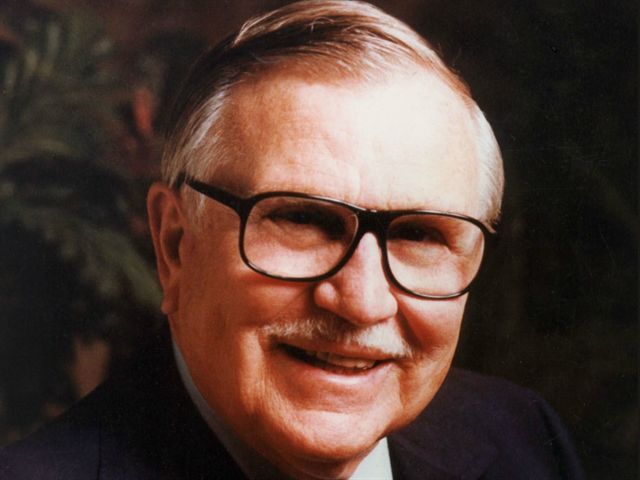
About Dr. J. Vernon McGee
John Vernon McGeewas born in Hillsboro, Texas, in 1904. Dr. McGee remarked, "When I was born and the doctor gave me the customary whack, my mother said that I let out a yell that could be heard on all four borders of Texas!" His Creator well knew that he would need a powerful voice to deliver a powerful message.
After completing his education (including a Th.M. and Th.D. from Dallas Theological Seminary), he and his wife came west, settling in Pasadena, California. Dr. McGee's greatest pastorate was at the historic Church of the Open Door in downtown Los Angeles, where he served from 1949 to 1970.
He began teaching Thru the Bible in 1967. After retiring from the pastorate, he set up radio headquarters in Pasadena, and the radio ministry expanded rapidly. Listeners never seem to tire of Dr. J. Vernon McGee's unique brand of rubber-meets-the-road teaching, or his passion for teaching the whole Word of God.
On the morning of December 1, 1988, Dr. McGee fell asleep in his chair and quietly passed into the presence of his Savior.
Contact Thru the Bible with Dr. J. Vernon McGee
Mailing Address
Thru the Bible, Inc.
P.O. Box 7100
Pasadena, CA 91109
In Canada:
Box 25325,
London, Ontario
N6C 6B1
Phone Number
(626) 795-4145 or
(800) 65-BIBLE (24253)


