Exodus 24:1—25:9
Ministries > Thru the Bible with Dr. J. Vernon McGee
https://www.oneplace.com/ministries/thru-the-bible-with-j-vernon-mcgee/
Facebook Twitter Instagram YouTubeRemember how terrified Israel was of God when He gave them the Law? It doesn’t have to be that way. Exodus 24 teaches us that, although we cannot possibly keep the entire Law, God enables us to draw near to Him through His infinite grace and, ultimately, His Son Jesus.
References
Dr. J. Vernon McGee: How firm a foundation ye saints of the Lord is laid for your faith in his excellent word.
Steve Schwetz: What's something in our spiritual lives that's as slippery as it is subtle? We'll find out more in this study on Thru the Bible. I'm Steve Schwetz, welcoming you aboard the Bible bus. We're on a five-year journey through the whole Word of God, taking it chapter by chapter and book by book, through the peaks and valleys of the Old Testament and then the New Testament and back again. You know, it's common to hear someone say, "Well, you've just got to trust your heart." Well, as we journey through our study of Exodus 24 with Dr. J. Vernon McGee, we're going to learn the exact opposite, that we often deceive ourselves into thinking we're on the right track. It's so subtle and it's scary. As Jeremiah 17:9 says, "The heart is deceitful above all things and desperately wicked." What's the bottom line? We can't always trust our hearts, can we? We'll learn more about the danger of self-deception in just a minute. Before we get to our study though, we got a couple of minutes to hear from some fellow listeners. This voicemail from Zoran makes me smile.
Zoran: Hello, guys. This is Zoran from Montreal. Some 20 years ago or so, I was driving my truck through the Western New York, I believe, and then I heard the first time Dr. McGee and I thought about this guy. I said, "Well, he must be from Eastern Europe." I just love his sense of humor and and stories from Bible. And I just got addicted to it, and I just love it and I'm continuing to listen to your program and learning about our Savior and Lord Jesus Christ. Thank you so much for your program. Blessings to you, guys, from Montreal.
Steve Schwetz: Well, it's great to hear from you, Zoran. You made me laugh with your comment about Dr. McGee being from Eastern Europe. He would have loved that. You know, one of the things that Dr. McGee loved most was sharing listener letters. So, the whole Bible bus family could hear how God was working in the lives of fellow passengers around the world. These stories remind us that we're not taking this journey alone. God's at work in amazing ways in all kinds of places and through His Word. And that's why we still share them today to share God's goodness, to celebrate changed lives and to remind us all that there's always room for more on the Bible bus. So, if you haven't gotten in touch recently, we want to hear from you. Why don't you tell us how God is shaping your story as we spend time in His Word together? Call and leave a voicemail. You can do it anytime, it's simple. Just go to 1-800-65-BIBLE, or you can always drop us a note in our app. You can even speak it into the app, it's super easy to do that. You can email Bible [email protected] and you can always write to Box 7100, Pasadena, California 91109. In Canada, Box 25325, London, Ontario N6C 6B1. Let's pray. Heavenly Father, thank You for Your Word and the way Your Spirit uses it to get our attention. Would You remove the veil that blinds us to the way that we deceive ourselves? Thank You for Your grace and mercy, in Jesus' name we pray. Amen.
Dr. J. Vernon McGee: Turn to Exodus 24 as we go through the Bible with Dr. J. Vernon McGee. Now today in chapter 24 of Exodus, we're going to conclude this very brief section on social legislation. Began in chapter 21 through 24, and actually there's more that has to do with social legislation than with the Ten Commandments. The Ten Commandments are very brief, frankly, but the social legislation covers a great deal. And we'll find that there's much more to the Law than the Ten Commandments. Now I'm going to begin reading here in Exodus 24, verse 1.
Dr. J. Vernon McGee: And he said unto Moses, Come up unto the Lord, thou, and Aaron, Nadab, and Abihu, and 70 of the elders of Israel, and worship ye afar off.
Dr. J. Vernon McGee: Now, don't miss that. God says you're to come up to the mountain, but even these men who were in a very unique position were told to worship you afar off. Now, how different that is under Law than it was when God was bringing them on eagles' wings, which is grace. And that's the way God today saves us and leads us along life's pathway. And He says that we've been made nigh by the blood of Christ today. But you see, under Law now, they're told, "Worship you afar off."
Dr. J. Vernon McGee: And verse 2, And Moses alone shall come near the Lord, but they shall not come nigh, neither shall the people go up with him.
Dr. J. Vernon McGee: And Moses came and told the people all the words of the Lord, and all the judgments. And all the people answered with one voice and said, All the words which the Lord hath said will we do.
Dr. J. Vernon McGee: Now this is the second time that the children of Israel have given an affirmative answer when God asked them, "Did they want His Commandments? His Law?" And they said, "Yes." And they are very self-confident, self-sufficient, and actually, almost arrogant. All the words which the Lord has said, "will we do." And they don't have all of them yet. They have been given the Ten Commandments. And yet they think they can do it. And someone says, "Well, how in the world could they be so self-deceived?" Well, I don't know, that's something that puzzles me, because I know a great many people today that honestly think they are living by Law and that they're meeting God's standard. Self-deception is a terrible thing. I don't think frankly, there's anything quite like it. And you remember John had something to say about this matter of self-deception. He said that if we say that we have no sin, we deceive ourselves. You never deceive your neighbors, and you won't deceive your wife or your husband or your loved ones, but you sure can deceive yourself. If we say that we have no sin, we deceive ourselves. And the truth is not in us. Well, you'd think that a man that says he has no sin ought to have also a little truth in him. But John says that he deceives himself and there's no truth in him at all. And in case you missed it, John repeated that again in the first chapter, the last verse of First John, if we say that we have not sinned, we make Him a liar, and His word's not in it. Now, I didn't say it, friends. John said it. John said that if you say that you have not sinned, that you keep God's Law, then you've made God a liar. And friends, God's no liar. I wouldn't want to call Him that if I were you. So the best thing to do is not to boast of your goodness. My, the arrogance of these people, all the words which the Lord has said, "will we do." But they didn't do them. Now will you notice,
Dr. J. Vernon McGee: And Moses wrote all the words of the Lord, and rose up early in the morning and built an altar upon the hill, and 12 pillars according to the 12 tribes of Israel. And he sent young men of the children of Israel, which offered burnt offerings and sacrifice peace offerings of oxen unto the Lord. And Moses took half of the blood, and put it in basins, and half of the blood he sprinkled on the altar. And he took the book of the covenant, and read in the audience of the people and they said,
Dr. J. Vernon McGee: Listen to it. Now they've heard it, it's written down.
Dr. J. Vernon McGee: All that the Lord hath said will we do, and be obedient.
Dr. J. Vernon McGee: Now, these people certainly had confidence, and it was nothing in the world, of course, but self-confidence. They thought that they could do it. But they didn't do it. And that is self-deception of the worst kind, of course. We'll be obedient, they said to God, but they were not obedient to God. You know the natural man thinks that he can please God, but he cannot please God. You and I cannot please Him at all. You and I can't meet His standard. We forget that we are actually the members of a race that as far as God is concerned, is totally depraved. You and I belong to those that are disobedient to God. And if you would doubt that, why don't you look around you in the world today? Look at all of the lawlessness, look at the sin that's in the world, the confusion that's in the world and the atheism and godlessness that's in the world. Friends, God's accurate when He tells us that there are none righteous, no, not one. All you have to do is to look about you today. And we're living in a day when sin is called good, bad is called good. And Isaiah said that day would come. Well, we've certainly arrived there. Now, verse 8,
Dr. J. Vernon McGee: And Moses took the blood and sprinkled it on the people and said, Behold the blood of the covenant, which the Lord had made with you concerning all these words.
Dr. J. Vernon McGee: Now, even before He gives it to them, why these people are sprinkled with blood that let them know that there must be a sacrifice and that without shedding of blood, there's no remission of sins. God will repeat that many times for them. Life must be given up. The penalty must be paid. If you and I are ever to go to heaven. Now will you notice,
Dr. J. Vernon McGee: Verse 9, Then went up Moses, and Aaron, Nadab, and Abihu, and 70 of the elders of Israel. And they saw the God of Israel. And there was under His feet as it were a paved work of a sapphire stone and as it were the body of heaven in His clearness.
Dr. J. Vernon McGee: Now again and again, this occurs, and there is confusion. I recognize in the way that our translation gives it, they saw the God of Israel. Candidly, they didn't see Him. God is a spirit, and no man has seen God at any time. They saw the representation of God, of course. And that is what you have when you get to the Book of Revelation. You feel like when you get there that when John's caught up to heaven, he saw a throne and in the midst of the throne. You feel like holding your breath. Well, my, we're at last going to see God. And you read that, it's nothing in the world but a representation of God. I do not want to get into this part of the argument, but I sincerely doubt whether we shall see God, the Father throughout eternity. I'm of the opinion that the closest we'll ever get will be to see the Lord Jesus Christ. And after all, that's the only way we can know God today is through Him. I do not know how He looks, I do not know how He feels. I do not know how He thinks. His thoughts are way above my thoughts, and His ways are different than my ways. Therefore, He must reveal Himself. Now, what they saw here was a representation of God. And it's quite evident, there were under His feet as it were a paved work of a sapphire stone, and as it were the body of heaven in His clearness. Does that tell you anything about God, my friend? Doesn't tell me a thing. It's just a representation that we have there.
Dr. J. Vernon McGee: And upon the nobles of the children of Israel, He laid not his hand. Also, they saw God and did eat and drink.
Dr. J. Vernon McGee: Now, this was a representation. You will remember later on, Moses asked that he might see God because all he'd seen had been a representation. And he wanted to see Him. And you remember that that was the plea and the question of Philip, yonder in the upper room. "Show us the Father and it sufficeth us." And at that time, you remember the Lord said to this man, "He that hath seen me hath seen the Father." You want to see God, friends, you'll have to go through Jesus Christ. And I hear a great many people today, generally it's some man giving a testimony, some earnest layman, and he talks about that he was far from God and now he says, "I can come right directly into the presence of God." No, you don't. You have no right there. I have no right there. We don't come directly like that, friends. There is one mediator between God and man, the man Christ Jesus. Now, if you're going to come to God, you're going to come through Christ. He is the mediator. He's the daysman that Job talked about that would put one hand in God's hand, one hand in our hand, and bring us together. We don't go there on our own. We need to recognize that. Now, will you notice,
Dr. J. Vernon McGee: This is a tremendous representation we have here. We read now verse 13, And Moses rose up and his minister Joshua, and Moses went up into the mount of God.
Dr. J. Vernon McGee: You notice that Joshua is beginning now to get into the picture. And God was preparing him all the time to succeed Moses. He's a young man. Now notice what Moses said,
Dr. J. Vernon McGee: Verse 14, he said unto the elders, Tarry ye here for us until we come again unto you, and behold Aaron and Hur are with you, if any man have any matters to do, let him come unto them. And Moses went up into the mount, and a cloud covered the mount. And the glory of the Lord abode upon Mount Sinai, and the cloud covered it six days, and the seventh day he called unto Moses out of the midst of the cloud, and the sight of the glory of the Lord was like devouring fire.
Dr. J. Vernon McGee: You see, it was the glory of the Lord, and even that was like devouring fire on the top of the mount in the eyes of the children of Israel.
Dr. J. Vernon McGee: And Moses went into the midst of the cloud, and gat him up into the mount, and Moses was in the mount 40 days and 40 nights.
Dr. J. Vernon McGee: Now, during that time, he got the instructions that we have in the rest of this book. And now from chapter 25 through 30, you have the blueprint for the Tabernacle and the pattern for the garments for the high priest. And then you have the construction of the Tabernacle and the erection of it, and the fact it was filled with the glory of the Lord. So that here for about 15 chapters, 25 through 40 with the exception of about three chapters here when Moses went down and when they had made the golden cap. So that this is what he was getting up in the mount. And not only this, but the book of Leviticus, you will find he also was getting up there for you have the tabernacle and the service of it. And the very center of the children of Israel, the very center of their camp, the most important part was the Tabernacle because it was the place where they approached God. Now, I want to as we come now to chapter 25, and I probably first should read this, first part of it.
Dr. J. Vernon McGee: And the Lord spake unto Moses, saying, Speak unto the children of Israel, that they bring me an offering of every man that giveth it willingly with his heart he shall take my offering.
Dr. J. Vernon McGee: Now, these people are just out of slavery. They've just been out of slavery just a few months. And now they're asked to make a contribution to the Lord. And it's an amazing contribution that these people made to the Lord. By the way, they brought more than enough. This is the only time I've ever heard of it that people were asked to stop giving. After they'd given enough to make the Tabernacle, Moses had to put up the stop sign and say, "We've got enough." I've never heard that before, and I'm sure it's never been my experience and probably not your experience. Now, they are slaves and they're to bring these offerings, and this is what they're to bring.
Dr. J. Vernon McGee: Verse 3, and this is the offering which you'll take of them. Gold, and silver, and brass. And blue, and purple, and scarlet. That was evidently the colors that they used in the land of Egypt, and they're still as bright today when they find them in the tomb. Believe me, the colors that these people use were remarkable. And either it was the color or it was cloth, that's colored. And I'm of the opinion that they dyed all the material that they used in the Tabernacle. Blue and purple and scarlet and fine linen. And this is that fine twine, Egyptian byssus linen. And we'll talk about that later. And goat's hair, and ram skins dyed red, and badger skins, and that's sealskins, by the way, and shittim wood. Oil for the light, spices for anointing oil, and for sweet incense. Onyx stones, and stones to be set in the ephod, and in the breastplate.
Dr. J. Vernon McGee: Now, these were the things they were to bring. And the question arises, where'd they get them? These people are just out of slavery. You will recall that we have seen where they were told to go to their masters and borrow. That's the way our translation reads. Actually what it means, they were given this. And they were to ask it as back wages. Now they've got 400 years of back wages to collect. It said they spoiled the Egyptians. They took out a tremendous wealth. And it's estimated that at least $5 million of material went into the construction of the Tabernacle alone. It was very small because it had to be carried on the wilderness march. But it was a very ornate, rich, beautiful thing. It was a thing of beauty.
Dr. J. Vernon McGee: Now, verse 8 of chapter 25, and let them make me a sanctuary that I may dwell among them.
Dr. J. Vernon McGee: Now notice, God never said that He was going to live in the Tabernacle. In fact, of the matter is, He did not. It said He dwelt between the cherubim, by the way. And that is important to see. You see, Israel was a theocracy. That is, Jehovah was King. That was the great song of Moses when they crossed the Red Sea, you will recall. He sang that song in which he said very definitely that God was the King. It was a great song of redemption. And the Lord is a man of war, and that He is King. Jehovah is King. And now these people are to be ruled over by God. And the ark was really God's throne. He didn't sit upon it. It was between the cherubim. In other words, he actually didn't touch down to tell the truth. He dwelt between the cherubim, and that's where they met Him. This idea today that God dwells in a building made with hands is not true. The Bible does not teach that. That's a heathen pagan notion. And a great many people call the church building today and they call it the church and they call it God's house. Well, it's not. God doesn't dwell in a house, friends. And He never did. But this is a place where He met with them. It was a meeting place and it was to teach them that. And the ark in there was God's throne. And that, by the way, will be the first article of furniture that they were to build. God didn't sit upon it, but He did sit between the cherubim. And Psalm 99:1 reads,
Dr. J. Vernon McGee: The Lord reigneth, let the people tremble. He that sitteth between the cherubim.
Dr. J. Vernon McGee: And therefore we'll find when we come to it, the ark is the most important article of furniture. It's given here next. That will be that which we are to see. We'll not get very far there today. Now will you notice,
Dr. J. Vernon McGee: Verse 9, According to all that I show thee after the pattern of the Tabernacle and the pattern of all the instruments thereof, even so shall ye make it.
Dr. J. Vernon McGee: Now, it was a pattern of the one in heaven. We're told that over in the Epistle to the Hebrews, and we'll see that later on, that the Tabernacle was made like the one in heaven. Now the question arises, is there a literal Tabernacle in heaven? And I take the position that there is. You're going to find out, those of you that are new to our study that I take the Bible very literally. I have a very, I suppose, naive notion that when God says something, He means it. And that if He means something else, He'll make that clear to us also. And I think that He made it very clear that there was one in heaven. And we'll have occasion to refer to that later on, and especially when we get to the Epistle to the Hebrews. We come now to the first article of furniture that's mentioned. Now those of you who have our notes, and I hope all of you get the notes, you're going to find that I have in there a diagram of the floor plan of the Tabernacle. Now the Tabernacle was built 30 cubits by 10 cubits. And outside was a fence around it, and it was 100 cubits by 50 cubits. And in that outer court that was formed by the Tabernacle and this fence that was around it, and it was, by the way, five cubits high. Why, we find two articles of furniture, the brazen altar and the laver. And then the Tabernacle proper was divided into two compartments, the Holy Place and the Holy of Holies. And the Holy Place was 20 by 10 cubits, the Holy of Holies was 10 by 10, and it was 10 cubits high. And this was really the Tabernacle proper. These two compartments formed one. And the first compartment was the Holy of Holies. That was where the ark was. Then when you moved outside, you have the Holy Place and the three articles of furniture there. The golden lampstand, the Table of Showbread, and the Altar of Incense. I do hope you'll get the notes and outlines here, friends. You'll find them extremely helpful. And now tomorrow, we're going to take up the construction of the Tabernacle, and we'll start with the ark here in verse 10 of Exodus 25. And so until next time, may the Lord richly bless you, my beloved.
Steve Schwetz: Those notes and outlines are available for free download in our digital book briefing the Bible over at TTB.org. Or call us at 1-800-65-BIBLE and we'll send an abridged copy by mail. And if you listen by app, you'll find briefing the Bible right there. I'm Steve Schwetz and I'll save you a seat as the Bible bus rolls along next time.
Dr. J. Vernon McGee: Jesus paid it all. All to Him I owe. Sin had left a crimson stain. He washed it white as snow.
Steve Schwetz: Thru the Bible is a five-year study of God's entire word, and together we discover God's purposes in history and our lives, found only when we believe in Jesus Christ. Do you know Him yet?
Related Episodes
Exodus 22, 23
Monday, September 28
Exodus 20:18—21:36
Friday, September 25
Exodus 20:1-17
Thursday, September 24
About Thru the Bible
Thru the Bible takes the listener through the entire Bible in just five years, threading back and forth between the Old and New Testaments. You can begin the study at any time. When we have concluded Revelation, we will start over again in Genesis, so if you are with us for five years you will not miss any part of the Bible.
Other Thru the Bible Programs:
Thru the Bible - Minute with McGee
Thru the Bible - Questions & Answers
Thru the Bible - Sunday Sermon
About Dr. J. Vernon McGee
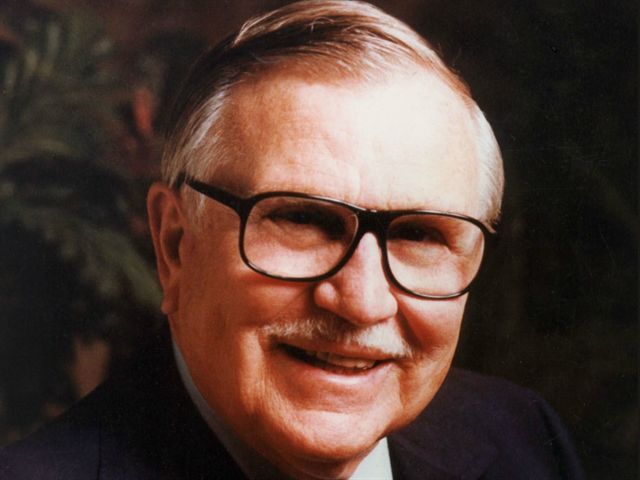
John Vernon McGeewas born in Hillsboro, Texas, in 1904. Dr. McGee remarked, "When I was born and the doctor gave me the customary whack, my mother said that I let out a yell that could be heard on all four borders of Texas!" His Creator well knew that he would need a powerful voice to deliver a powerful message.
After completing his education (including a Th.M. and Th.D. from Dallas Theological Seminary), he and his wife came west, settling in Pasadena, California. Dr. McGee's greatest pastorate was at the historic Church of the Open Door in downtown Los Angeles, where he served from 1949 to 1970.
He began teaching Thru the Bible in 1967. After retiring from the pastorate, he set up radio headquarters in Pasadena, and the radio ministry expanded rapidly. Listeners never seem to tire of Dr. J. Vernon McGee's unique brand of rubber-meets-the-road teaching, or his passion for teaching the whole Word of God.
On the morning of December 1, 1988, Dr. McGee fell asleep in his chair and quietly passed into the presence of his Savior.
Contact Thru the Bible with Dr. J. Vernon McGee
Mailing Address
Thru the Bible, Inc.
P.O. Box 7100
Pasadena, CA 91109
In Canada:
Box 25325,
London, Ontario
N6C 6B1
Phone Number
(626) 795-4145 or
(800) 65-BIBLE (24253)


