When an Election Doesn’t Go Your Way, What Happens to Your Hope?
Guest Commentary


Audio By Carbonatix
By Shawn Paul Wood, Crosswalk.com

Key Points
- Elections have real consequences, but no political victory or defeat can replace the hope Christians have in Christ.
- James Madison recognized that political factions are inevitable in a free society, which is one reason the constitutional system limits concentrated power.
- Political disagreement does not erase the God-given dignity of people who vote differently from us.
- Christians can pray for leaders they oppose, hold them accountable, and remain engaged without placing ultimate trust in political power.
- Christian hope is rooted in the resurrection of Jesus Christ, not polling numbers, party control, or election results.
Somewhere in America, a voter is staring at the election results, wondering how so many people could have gotten so much wrong.
The television is still on. Commentators are dissecting precincts and percentages. Someone online has declared the death of democracy for approximately the seventh time this decade. Another notable is threatening to move to Canada, presumably before discovering how difficult Canadian immigration and healthcare actually are.
Meanwhile, the winning side is celebrating as though its candidate scored the winning touchdown in the Super Bowl. Party-colored confetti, political trash talk, and extoling the greatness of the winning candidate’s commercials (even though everyone hated those ads).
We've become remarkably good at treating elections like sporting events. We cheer for our teams, defend our players, and boo the opposition. As Jerry Seinfeld once joked about sports fandom, “we're essentially cheering for laundry.”
The uniforms change, but our loyalties survive. If only they weren’t based on party alone.
Of course, politics has more serious consequences than a losing season. Elections affect schools, healthcare, public safety, and household finances. According to the American Psychological Association's 2026 Stress in America report, 74% of U.S. adults say the nation's future is a significant source of stress. Those concerns deserve attention.
But when our preferred candidate loses, what exactly have we lost? And when the candidate wins, what have we gained that makes us feel so secure? The fulcrum of that emotional seesaw should be our faith—should be.
Why Did James Madison Warn about Political Factions?
In Federalist No. 10, James Madison warned about “factions”: groups united by interests or passions that could threaten the rights of others or the public good.
He wasn’t talking about professional wrestling bad guys, street gangs, or even some fancy Broadway production. Madison was alive when this country was in its discovery phase, and even then, partisan death knells and a loss of hope each election cycle were a thing.
The future Father of the Constitution and 4th U.S. president understood that disagreement was inevitable wherever people enjoyed liberty. His concern was what happened when loyalty to a faction displaced justice.
Madison distinguished a pure democracy, in which citizens govern directly, from a republic, in which they choose representatives. Now bookmark this: America became a constitutional republic operating through representative democracy. Both descriptions are accurate. Our system distributes power and establishes checks so that no election gives one faction unlimited authority.
The Constitution's Preamble speaks of justice, domestic tranquility, general welfare, and liberty for future generations. Those aspirations belong to Americans who vote differently, too.
The founders didn't always live up to their ideals. Slavery and restrictions on political participation exposed profound contradictions. Yet, the constitutional framework also gave later generations ways to challenge injustice and extend rights.
Our government was designed to withstand disagreement. Whether our friendships, churches, and families can do the same is another question.
When Does Political Loyalty Become Personal Identity?
Somewhere along the way, supporting a candidate began to feel like defending a quarterback on the offensive line, and you weigh a sprite buck-o-five. In other words, talk politics and pack a lunch.
A disagreement over policy (or the individual making the policy) became an insult to our intelligence, morality, faith, or mother. Before long, we stopped listening to people and started looking for evidence that they belonged to the wrong team.
Christians aren't immune to this persnickety drama. We can discuss political opponents with a contempt we'd never use in Sunday school, then wonder why people doubt our claims about loving our neighbors. The sanctified can get into a dog-cussing match over opposite sides of the aisle faster than Usain Bolt with a harsh gastrointestinal problem.
Jesus called disciples from backgrounds that reflected the tensions of His day. Matthew had collected taxes in a system associated with Roman rule; Simon was called the Zealot (Matthew 10:3–4). Their presence among the Twelve reminds us that allegiance to Jesus could bring together people with sharply different histories.
Paul urged believers to act with humility and consider others' interests (Philippians 2:3–4). Jesus went further, commanding His followers to love their enemies and pray for those who persecute them (Matthew 5:44).
That doesn't require us to pretend every policy is equally wise or just. Some decisions carry grave moral consequences. Christians should speak clearly about them. But the person casting a different ballot remains someone made in God's image (Genesis 1:26–27).
When Samuel was impressed by the appearance of a potential king, God reminded him that people look at outward appearances, while the Lord looks at the heart (1 Samuel 16:7). A party label tells us remarkably little about what God sees in a person, much less about most politicians.
Does God Remain Sovereign When Our Candidate Loses?
Daniel knew what it meant to live under a government he hadn't chosen. He was taken from Jerusalem into Babylonian captivity; he served rulers whose decisions shaped his life and the lives of his people. Yet when God revealed Nebuchadnezzar's dream, Daniel praised the One who changes times and seasons, removes kings, and establishes kings (Daniel 2:20–21).
Nebuchadnezzar possessed enormous power. Daniel understood that it was temporary.
Psalm 146:3 warns against placing our trust in princes or human beings who cannot save. The psalmist wasn't declaring leadership irrelevant. He was recognizing its limits. Even a capable ruler cannot heal the human heart, defeat death, or offer the salvation Christians find in Christ.
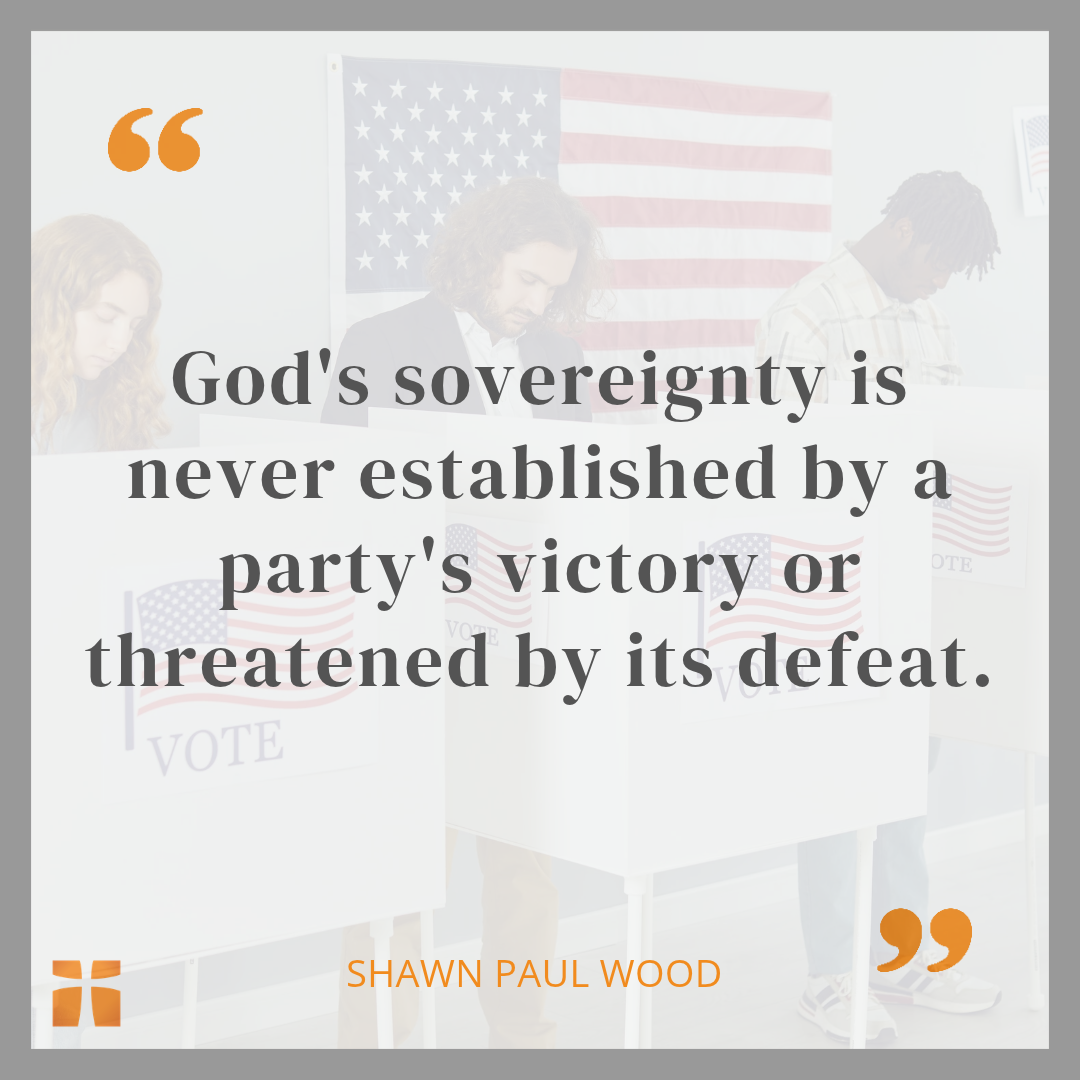
Isaiah 9:6 speaks of government resting upon the shoulders of the promised Messiah. Christians see its fulfillment in Jesus and His kingdom, not in the policies of any American administration. God's sovereignty is never established by a party's victory or threatened by its defeat.
Paul instructed believers to pray for kings and others in authority so they might live peaceful, godly lives (1 Timothy 2:1–2). He wrote in a Roman world where Christians had little political power. The command didn't depend on whether they admired their rulers.
As Christianity.com explores in Christians and American Politics, political participation and allegiance to Christ need not compete for our ultimate loyalty.
We can pray for leaders we oppose, ask God to grant them wisdom, and hold them accountable when they act unjustly. Scripture recognizes governing authority (Romans 13:1–7), while also showing believers refusing commands that conflict with obedience to God (Acts 5:29).
Prayer isn't an endorsement. Accountability isn't hatred. Both can arise from the same desire for our neighbors' welfare.
What Happens When We Begin Looking at the Heart Again?
After an election, the signs disappear, the advertisements stop, and candidates begin governing or preparing their next campaigns. The rest of us return to grocery bills, medical appointments, school pickups, and work.
Those problems don't vanish because one party wins. The cost of living reflects a complicated mixture of public policy, market conditions, business decisions, and personal behavior. Theft and corporate misconduct impose costs; so can poor regulation and irresponsible leadership. No election can repair every failure of human character.
The prophet Micah described what God requires: to do justice, love mercy, and walk humbly with Him (Micah 6:8). Those responsibilities don't expire when the votes are counted.
Jeremiah delivered an astonishing instruction to Jewish exiles in Babylon. They were to seek the welfare of the city where they had been taken captive and pray for it (Jeremiah 29:7). Imagine being told to care about the flourishing of a place ruled by people you never chose, after losing your own home.
The exiles had every reason to grieve. Their losses were real, and their circumstances unjust. Yet they still had neighbors to care for and a community in which to live faithfully.
That's a harder calling than posting another furious election-night declaration. It asks Christians to remain engaged, advocate for justice, help struggling families, and treat people with dignity even when political disagreements remain unresolved.
Where Should Our Hope Rest after an Election?
Peter called the resurrection of Jesus Christ the source of a living hope (1 Peter 1:3). The Greek word elpis denotes expectation or hope; in Peter's letter, that hope is grounded in what God has done through Christ. It doesn't rise and fall with polling numbers.
As Hope Bolinger writes in Christianity.com's Our Hope Is Rooted in Christ, Not Politics, political anxiety can become overwhelming when believers forget where their lasting confidence belongs.
America's founders understood that imperfect people needed institutions capable of restraining power. Scripture tells us that institutions, however necessary, cannot transform the human heart. We need wisdom in government and integrity in public life, but our deepest hope lies elsewhere.
The candidates will change. Parties will win and lose. We'll keep arguing about the best way forward, sometimes loudly and occasionally over Thanksgiving dinner.
But the One who holds our ultimate hope never appears on a ballot. And thankfully, He never has to win an election.
Frequently Asked Questions
How Should Christians Respond When Their Candidate Loses?
Christians can acknowledge real disappointment while resisting despair, contempt, or fear. Scripture calls believers to pray, remain faithful, love others, and remember that God’s sovereignty does not depend on election results.
Does God Remain Sovereign after an Election?
Yes. Scripture repeatedly presents human rulers as temporary while God’s authority remains permanent. Political outcomes may affect our lives, but they do not threaten God’s rule.
Can Christians Disagree Politically?
Yes. Christians may disagree about candidates and policies while still being united in Christ. Political affiliation does not determine whether someone bears God’s image or belongs to Christ.
Should Christians Pray for Leaders They Oppose?
Yes. First Timothy 2:1–2 calls believers to pray for those in authority. Prayer does not require political approval or prevent Christians from speaking against injustice.
Where Should Christians Place Their Hope during Elections?
First Peter 1:3 grounds Christian hope in the resurrection of Jesus Christ. Political leadership changes, but the Christian’s ultimate confidence rests in Christ and His kingdom.
For Further Reading
- Our Hope Is Rooted in Christ, Not Politics
- Christians and American Politics
- How Can Christians Stay Christlike in a Divisive Election?
- Is Voting a Christian Responsibility?
- Is Christian Political Participation a Sacred Duty or a Civil Right?
Photo Credit: ©Getty Images/Boy Wirat
 Shawn Paul Wood, Th.D., is an award-winning copywriter, storyteller and ghostwriter of faith-based books, speeches and columns for brands, spiritual leaders and Christian public figures. With more than 20 years in communications and marketing, he founded Woodworks Communications, where he leads a team of SEO, AI and content strategists. His team helps faith-based, nonprofit and mission-minded organizations turn unclear messaging into clear strategy, strong websites and stronger visibility across search and AI, including AEO, GEO, SXO and AIO. He lives in the Dallas/Fort Worth area.


